
Cardboard cartons
Planning advantage
- Flexible size mix and no rental return deadline.
Check
- Condition, sealing supplies and the end-of-use plan.
Compare cardboard cartons with reusable moving bins using packed dimensions, empty weight, rental timing, labels and the cost of the entire return cycle.
Compare cardboard cartons with reusable moving bins using packed dimensions, empty weight, rental timing, labels and the cost of the entire return cycle.
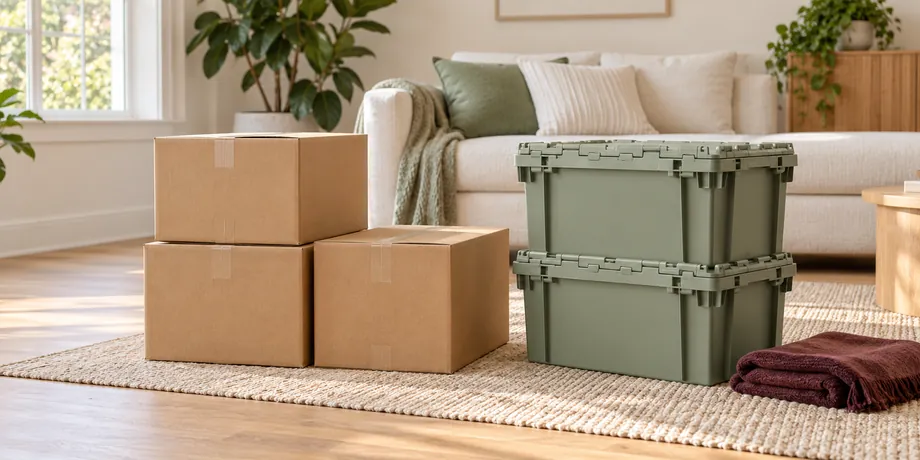
Cardboard cartons and reusable plastic bins solve different logistical problems. Cartons can be purchased in a mix of dimensions and kept while you unpack. Rented bins may simplify delivery and collection, but their return date becomes part of your moving schedule. Review the actual product and agreement rather than assuming every bin service has the same sizes or terms.
Measure usable interior space and outside dimensions. Tapered sides, lids and handles can make a bin's advertised volume different from the rectangular space it occupies in the truck. Record empty weight too, since it contributes to packed weight and vehicle payload even before any belongings are added.
| Decision point | Cardboard cartons | Reusable bins |
|---|---|---|
| Size mix | Select several purchased sizes | Confirm available sizes and lids |
| Unpacking deadline | Set your own disposal schedule | Follow rental return deadline |
| Empty storage | Usually flatten after use | Check nesting and collection space |
| Labels | Write on or apply suitable labels | Follow removable-label requirements |
| Cost | Boxes, tape and disposal or reuse | Rental, delivery, collection and extensions |
Suppose 30 cartons cost an assumed $2.50 each, with $18 of tape: $93 before any additional charges. A hypothetical bin package costs $100 plus $20 for delivery and collection: $120. If the bin return slips into an additional $30 rental period, its scenario total becomes $150. These are invented comparison inputs, not prices charged by any provider.
The $27 initial difference means little if the two packages have different usable sizes or the carton plan omits necessary specialty packaging. Add the same required protection and handling supplies to both columns, then compare the actual inventory they can accommodate.
Fill one sample with representative contents and weigh it. Confirm the lid closes without pressure on fragile objects and that handles remain usable. Follow the manufacturer's loading and stacking guidance. A rigid container does not automatically make delicate contents safe, and neither container type eliminates cushioning needs.
Choose a realistic unpacking completion date before renting. Set aside space for empty bins and verify collection access at the new home. If you expect an uncertain delivery window or storage stay, price the extension rather than assuming a short rental will suffice.
For purchased cartons, plan reuse or recycling and avoid accumulating damaged boxes for a future move. For rented bins, count all bins and lids at delivery and return, document condition and retain the collection confirmation until the account is settled.
Planning advantage
Check
Planning advantage
Check
Bottom line
Choose the container system whose verified capacity and unpacking timeline match your move, then compare complete costs.
Reviewed October 22, 2026. Workflows, quantities and USD examples are editorial planning scenarios, not market averages or a carrier quote. Confirm the terms for your move.
Decide where new and used moving boxes fit your packing plan by inspecting condition, matching dimensions…
Comparison
Price a carton mix, tape and other supplies using your own unit prices, whole-item rounding and a separate…
Calculator
Unpack in an order that restores sleep, food, hygiene and essential work first, while keeping inventory checks…
Guide
Inventory hobby equipment by complete working sets, fragile parts and restricted…
Choose moving box sizes from the items you own, then test packed weight, outside…
Decide where new and used moving boxes fit your packing plan by inspecting condition,…
Estimate packing tape from a measured sealing pattern, box count and reserve, then round…
Thank you! Your feedback helps us make this page better.
Could not send. Please try again.