
Separate personal, shared and undecided belongings before a roommate move, with clear package owners, pickup dates and expense records.
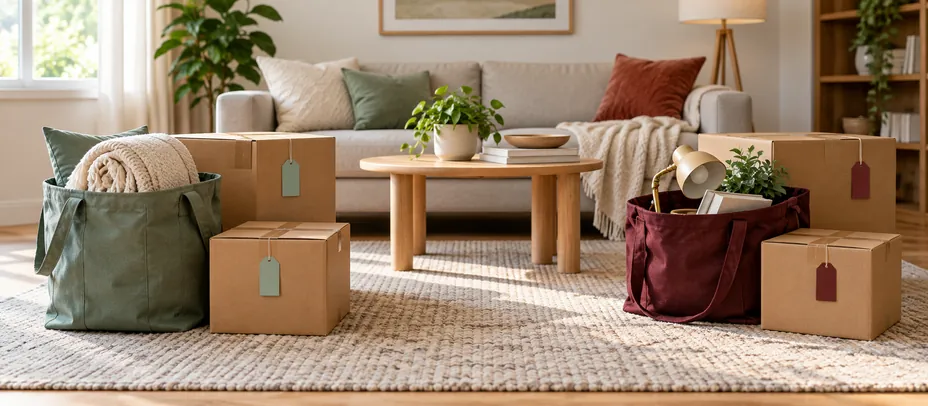
Agree on ownership before packing starts
Make one shared inventory with three statuses: individual owner, agreed recipient and unresolved. Start with obvious personal belongings, then review jointly purchased furniture, kitchen equipment and household supplies. Keep the discussion separate from the loading appointment; a crew waiting beside a disputed sofa cannot resolve the household's agreement.
Use photographs and purchase records where they help clarify what exists. Record the roommates' agreed outcome in plain language, including any payment or pickup arrangement. This is an organizing method, not a statement about legal ownership or lease obligations. Seek appropriate advice separately when a disagreement cannot be resolved.
| Item | Current status | Agreed action | Deadline |
|---|---|---|---|
| Bedroom desk | Alex's personal item | Pack for Alex's new home | Before quote is finalized |
| Shared microwave | Agreed recipient: Sam | Remains with Sam | Confirm in inventory |
| Dining table | Unresolved | Compare purchase record and options | One week before pickup |
| Cleaning supplies | Shared consumables | Keep for final cleaning, then allocate | Handover day |
Label the destination and owner separately
A carton marked “kitchen” is ambiguous when two people are moving to different homes. Add an owner or destination code, such as A-K-01 and S-K-01, while retaining a readable room label. Use physical staging zones for each destination if space permits. Do not place unresolved belongings in either confirmed loading zone.
If 18 cartons go to one address and 14 to another, the combined count is 32, but each delivery has its own reconciliation total. If both shipments use one vehicle, provide the carrier with the planned stops and separate inventories. Ask about additional-stop pricing and loading order rather than assuming the second address is included.
Track joint costs without duplicating them
Suppose an illustrative shared transport bill is $480 and the roommates agree to split it evenly. Each share is $240. If Alex already paid a $100 deposit credited to that bill, Alex's remaining share is $140 while Sam's is $240; the carrier's unpaid balance is $380. Confirm the chosen split rather than treating equal shares as an automatic rule.
Assign final tasks by name: cleaning, utility-account contact, shared-area walkthrough and return of the items the property requests. Check the lease and provider agreements for actual account or notice requirements; the roommate task list does not change them. Before pickup, sign off the item decisions together and retain the final version. After both deliveries, confirm the agreed packages arrived and settle documented shared expenses using receipts rather than memory.
Reviewed October 22, 2026. Workflows, quantities and USD examples are editorial planning scenarios, not market averages or a carrier quote. Confirm the terms for your move.
Use this plan with
-
Create a Room-by-Room Moving Inventory
Create a moving inventory that follows each item from its original room to its delivery location, including…
Guide
-
Plan Moving Payments by Due Date
Map moving deposits, rental holds and delivery payments onto a calendar so a manageable total does not hide…
Guide
-
Coordinate Utilities Between Two Homes
Coordinate utility shutoff and activation with possession dates, final readings and account confirmation while…
Guide
Related tools & guides
-
Guide
Handle a Building Moving Insurance Certificate
Coordinate a building’s moving insurance paperwork with the mover and insurance…
-
Guide
Plan a Move Within the Same Building
Plan a move within one building by package count, shared access and room readiness, even…
-
Guide
Schedule Apartment Move-Out Cleaning
Schedule apartment cleaning after the right items leave, using a room-by-room handoff…
-
Guide
Decide How Much Lease Overlap a Move Needs
Compare extra housing days with storage, rushed service and repeated trips, using your…