
Three rules
Slower, earlier, higher
drive slower than you would in a car, brake earlier, and know the truck’s height — from 9 ft for a 10 ft truck to 12 ft for a 26 ft truck in U-Haul’s published figures
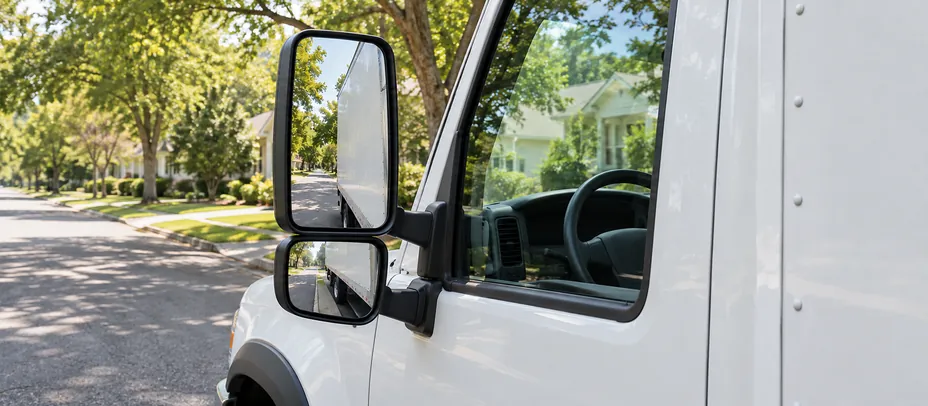
A moving truck is not hard to drive, but it behaves differently from a car in ways that matter most at the worst moments: when you brake, when you back up and when something overhead is lower than you think. The points below summarize what the rental company’s own truck instructions emphasize, in our words, with the reasons behind them. Read the instructions for the specific truck you receive before you drive.
Before you leave the lot
- Find the weight label Every rental truck has a label on the driver’s door post with its gross vehicle and axle weight ratings; the load must stay within them.
- Learn the height Note the clearance height. Overhead obstructions are often not posted; if you are unsure, stop and check before driving under.
- Set mirrors and seat There is no rear window view; mirrors are all you have. Adjust them before moving.
- Stow the ramp Confirm the loading ramp is fully stored and latched before driving off.
On the road
A loaded truck takes much longer to stop than a car. Drive below the speed you would choose in a car for the same road, leave a long gap to the vehicle ahead and brake early. On long downhill grades, slow down and use a lower gear rather than riding the brakes. Slow down well before curves and exits, and more in wind, rain or construction zones; a tall box catches crosswinds.
If the truck is pushed off its line by wind, a passing vehicle or a rough road, the rental instructions say to ease off the accelerator rather than steering hard or braking. If a wheel drops off the pavement, do not brake: slow down gradually below about 25 mph, then steer back onto the road gently and rejoin traffic carefully.
Height, backing and parking
U-Haul publishes clearance heights of 9 ft for its 10 ft truck, 11 ft for the 15 and 20 ft trucks and 12 ft for the 26 ft truck. Drive-through lanes, gas-station canopies, parking garages, motel overhangs, balconies, eaves, tree limbs and wires are the usual hazards, and many are not posted. Plan fuel stops and overnight parking with room to pull through.
Backing up is where the blind spots of a box truck matter most. Use a helper who stands where you can see them and who stays out of the truck’s path; if no one is available, get out and walk around the back first. When parking, set the parking brake firmly before putting the transmission in park, and turn the wheels toward the curb when facing downhill and away from it when facing uphill.
Load and people
Load the heaviest items first, at the front and on the floor, and keep the load tight so it cannot shift; a partial load should be tied near the front. Never let anyone ride in the cargo area. Do not load gasoline, propane, paint thinner or other flammables — even an almost empty container — and drain fuel from mowers and stoves before loading.
Fatigue is the risk people underestimate on a long move. Do not drive drowsy, avoid night driving where you can, and plan daily distances with rest stops rather than a fixed number of hours behind the wheel. If you feel sleepy, stop; caffeine and an open window are not a substitute for rest.
Is it hard to drive a 26 ft moving truck?
It needs more space and attention than a car: longer stopping distances, wide turns, a 12 ft clearance height and no rear view. Practice in an empty lot, plan the route and use a helper for backing.
How fast should I drive a moving truck?
Slower than you would drive a car on the same road, with a longer following distance and earlier braking, and slower again in wind, rain and on downhill grades.
Prepare for the drive
-
Plan a Rental Truck Route for Height Limits
Plan a moving truck route using the assigned vehicle height, verified access points and a backup route for…
Guide
-
Do You Need a CDL to Drive a 26 ft Moving Truck?
What the federal CDL weight classes say, why consumer rental trucks are rated at 25,999 lb, and what state and…
No CDL by federal weight class
-
Inspect a Rental Truck Before Departure
Inspect your rental truck before departure, document existing condition and verify the assigned equipment,…
Guide
-
Build a Cross-Country Moving Drive Schedule
Build a moving road schedule from route segments, rest stops, lodging access and arrival needs instead of…
Guide
-
Moving Fuel Calculator
Estimate moving-trip gallons and fuel cost from your route, loaded fuel economy and an optional mileage…
Calculator
Sources checked October 26, 2026. Driving points summarize the rental company’s published truck instructions and NHTSA drowsy-driving guidance in our words; follow the instructions for the vehicle you receive.
- U-Haul — Truck User Instructions — Assigned vehicle inspection, operation and loading instructions; not a generic safe-loading certification. (Checked 2026-10-22.)
- NHTSA — Drowsy Driving — Rest before long travel; fatigue is a reason to stop, not increase driving speed. (Checked 2026-10-22.)
- U-Haul — 26 ft truck specifications — Published volume 1,682 cu ft. Assigned equipment may differ. Bedroom-based marketing is not a physical fit guarantee. (Checked 2026-10-22.)
- U-Haul — 10 ft truck specifications — Published volume 402 cu ft. Assigned equipment may differ. Bedroom-based marketing is not a physical fit guarantee. (Checked 2026-10-22.)
Related tools & guides
-
Guide
Plan a Rental Truck Route for Height Limits
Plan a moving truck route using the assigned vehicle height, verified access points and…
-
Guide
Do You Need a CDL to Drive a 26 ft Moving Truck?
No CDL by federal weight class
-
Calculator
Moving Truck Size Calculator: What Size Truck Do I Need?
Use home size and box count to screen truck volumes, then check packed dimensions,…
-
Chart
Moving Truck Sizes Chart: 10, 15, 20 and 26 ft
15 ft
-
Calculator
Rental Truck Cost Calculator
Add rental days, excess mileage, fuel and quoted fees for a moving truck, keeping included…