
Inspect your rental truck before departure, document existing condition and verify the assigned equipment, fuel level, controls and return details.
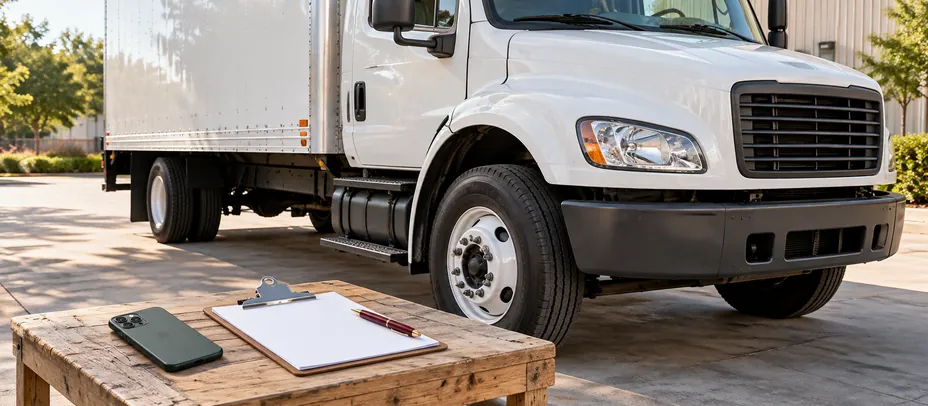
Allow time before the loading appointment
Make inspection part of the pickup schedule rather than squeezing it between signing and driving away. Bring the reservation, license information required by the provider and a phone with enough battery for photographs. Confirm the assigned vehicle and rental terms before relying on the equipment you expected to receive.
Walk around the truck with the provider's inspection process. Record existing exterior damage, cargo-area condition and equipment supplied. Photographs should show both a wide view and the specific mark, along with a way to identify the vehicle. Ask that discrepancies be recorded in the provider's system before departure.
| Inspection area | Record or confirm | Action on uncertainty |
|---|---|---|
| Vehicle identity | Unit number and agreed class | Match reservation or reassess substitute |
| Odometer and fuel | Readable starting photographs | Correct conflicting contract entry |
| Exterior and cargo area | Existing damage and condition | Report before leaving |
| Included equipment | Pads, dolly, straps if agreed | Count and check condition |
| Driver information | Clearance, controls and manual | Request explanation or correction |
Check suitability, not just appearance
Confirm cargo opening dimensions for your largest item and the applicable load limits. A substitute truck can have a different door or interior shape even when its advertised size sounds similar. Recheck your route's height restrictions, parking approach and loading arrangement against the actual vehicle.
Have the rental staff explain unfamiliar controls and the manufacturer's inspection steps. Check the items the provider instructs you to check, including relevant lights, mirrors and visible tire condition. Report warning lights, damaged equipment or operational concerns and obtain a resolution before driving. This is not a substitute for a mechanical inspection or the vehicle manual.
Capture the contractual starting point
Suppose the contract records 18,420 mi while the odometer reads 18,428 mi. Resolve the eight-mile discrepancy at pickup instead of arguing about it after return. Do the same for a fuel-level mismatch. These are illustrative numbers; the purpose is to establish a shared starting record.
Confirm the return branch, deadline, fuel requirement and after-hours instructions. Save the roadside-assistance contact outside the vehicle in a phone note or accessible document. Know which number handles a mechanical problem and which handles a rental extension.
Before departure, adjust the driving position and mirrors, secure loose cab items and read the assigned truck's operating instructions. If the truck is unsuitable or a safety concern remains unresolved, ask for a corrected arrangement. Replan the loading appointment after a delay rather than treating the reservation time as a reason to skip essential checks.
Reviewed October 22, 2026. Workflows, quantities and USD examples are editorial planning scenarios, not market averages or a carrier quote. Confirm the terms for your move.
- U-Haul — Truck User Instructions — Provider instructions for assigned equipment, loading and operation; read the vehicle manual before use. (Checked 2026-10-22.)
- U-Haul — 15 ft truck specifications — Published approximate volume 764 cu ft, door 7 ft 3 in by 6 ft 5 in and maximum load 6,385 lb; assigned equipment may differ. (Checked 2026-10-22.)
Use this plan with
-
Rental Truck Return Checklist
Close a rental truck booking with a documented return, confirmed fuel and mileage terms, and a separate record…
Checklist
-
Check Truck Payload Separately from Cargo Space
Check moving truck payload with a separate weight ledger, actual vehicle limits and bulky-item measurements…
Guide
-
Measure Furniture, Doors and Turning Space
Measure packed furniture against doors, hallways, stair landings and truck openings, then identify when…
Guide
Related tools & guides
-
Guide
Check Truck Payload Separately from Cargo Space
Check moving truck payload with a separate weight ledger, actual vehicle limits and…
-
Guide
Measure Furniture, Doors and Turning Space
Measure packed furniture against doors, hallways, stair landings and truck openings,…
-
Guide
Decide Whether Two Local Truck Trips Work
Test a two-trip local move against mileage, loading cycles, rental deadlines, elevator…
-
Guide
Plan Labor-Only Loading and Unloading Help
Plan labor-only loading and unloading with a defined inventory, equipment list, minimum…