
Plan a moving truck loading location with the provider and local authority, then connect the confirmed space to your carrying route.
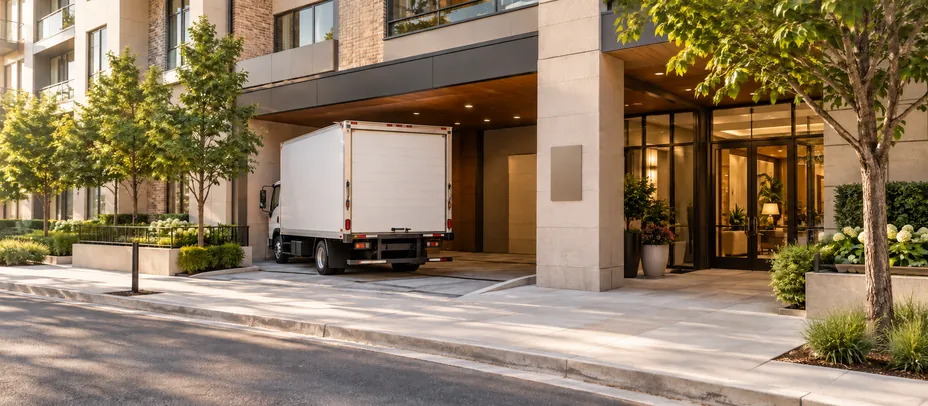
Identify the location before pricing the carry
Give the mover a proposed stopping point at each home, with photos and the measured route to the entrance. Include gates, slopes, turns and building access. A map pin at the front door is not enough when the actual loading area sits around the block or behind the building.
Ask the transport provider about the assigned vehicle and the operating room it needs. Vehicle length alone does not describe space for a ramp, liftgate or unloading activity. Obtain the relevant dimensions from the provider and compare them with the actual site. Avoid using a generic “moving truck space” measurement as an approval.
| Planning record | What to establish |
|---|---|
| Proposed location | Exact curb segment, driveway or loading bay |
| Vehicle and equipment | Provider-confirmed dimensions and operating area |
| Property process | Reservation, access hours and contact |
| Public-space process | Local authority's applicable rules and lead time |
| Carry route | Measured distance and obstacles |
| Backup location | Provider-reviewed route and possible cost effect |
Confirm who can authorize use
Ask the property manager about private loading areas and the relevant local authority about public space. Determine whether your specific plan requires a reservation, permit, signs or another procedure, and who is responsible for completing it. Rules differ by location; a neighbor's prior move does not establish permission for your date or vehicle.
Keep any authorization and conditions with the move folder. Do not assume that placing household objects at the curb reserves a legal space. If another vehicle occupies the agreed location, use the contact and response process provided by the authority or property manager rather than trying to move someone else's property.
Price a realistic backup
Suppose the preferred route is 45 ft from the truck to the entrance and the confirmed alternative is 135 ft. The alternative adds 90 ft to each one-way loaded carry, but that figure alone cannot predict labor time or a fee. Send both routes to the mover and ask how the quote changes under each scenario.
If the provider quotes an additional $80 for the alternative route, enter that as a conditional USD line with its trigger. Do not add both routes' charges to the base bill unless the move actually uses both under the agreed pricing. Recheck the site shortly before moving day for construction, closures or changes in access. Tell the crew immediately if the approved location is unavailable, and obtain agreement on any revised route and cost before the work changes.
Reviewed October 22, 2026. Workflows, quantities and USD examples are editorial planning scenarios, not market averages or a carrier quote. Confirm the terms for your move.
Use this plan with
-
Budget for Stairs, Elevators and Long Carries
Describe stairs, elevators, parking and carrying distances before requesting quotes, then separate fixed…
Guide
-
Check a Portable Container Delivery Site
Check a container delivery site with the provider and property manager before booking, including clearance,…
Guide
-
Assign Moving-Day Roles and Handoffs
Assign moving-day roles so access, inventory, household care and payment decisions have clear owners and…
Guide
Related tools & guides
-
Guide
Plan a Walk-Up Apartment Move
Prepare a walk-up move with measured stair access, an accurate inventory and a…
-
Guide
Coordinate an Elevator Reservation for Moving
Coordinate elevator reservations at both homes with the moving crew, including dimensions,…
-
Guide
Handle a Building Moving Insurance Certificate
Coordinate a building’s moving insurance paperwork with the mover and insurance…
-
Guide
Plan a Move Within the Same Building
Plan a move within one building by package count, shared access and room readiness, even…