
Describe stairs, elevators, parking and carrying distances before requesting quotes, then separate fixed access fees from added labor time.
Describe the route from room to truck
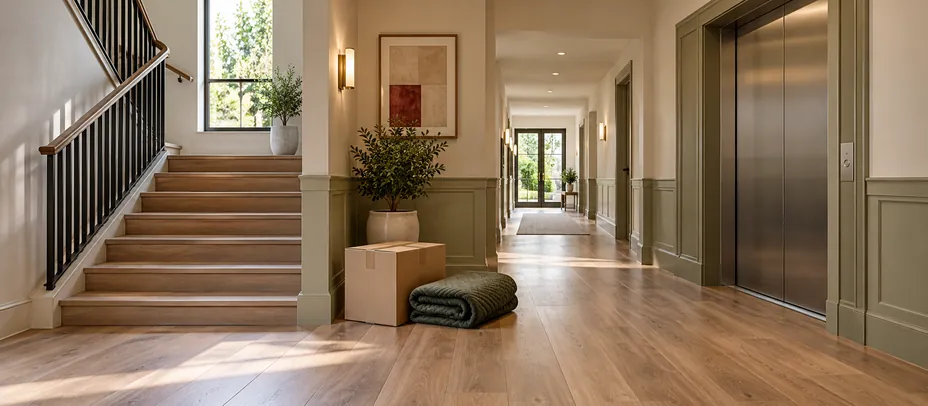
An address alone does not describe a move. The crew needs the floor, stair flights, elevator dimensions, distance from the loading point and any scheduled access window. Repeat the description for both homes and for storage. Photos help explain turns and landings, but measurements and building instructions are more useful than a wide-angle image that hides the narrowest point.
Give providers the same access sheet. Ask which conditions trigger a fee and how that fee is measured. A charge per flight, per item or per visit has very different consequences. There is no universal long-carry threshold across movers.
| Access detail | What to record | Pricing question |
|---|---|---|
| Stairs | Flights, landings, narrowest width | Fixed fee, hourly time or both? |
| Elevator | Door and cab sizes, reservation | Is waiting billable? |
| Carry | Measured route in ft | Where does a distance charge start? |
| Parking | Legal loading location and hours | Who arranges approval? |
| Large vehicle access | Clearance and turning limits | Is a smaller shuttle needed? |
Price one effect only once
Suppose a hypothetical quote includes $700 of labor and a $90 fixed stair charge. A second version includes $820 of labor because of the stairs and no separate stair fee. The totals are $790 and $820 before other exclusions. Adding the $90 fee to the second version without confirmation would count the same allowance twice.
Some contracts legitimately include both extra labor and a distinct access charge. Ask for the basis rather than assuming duplication. Resolve changed access in writing with the provider and obtain any required new estimate before loading. An elevator outage can change staffing, carrying route and duration together.
Reduce uncertainty before move day
Walk the planned route at the time deliveries are allowed. Confirm that parked vehicles, closed gates and loading-dock controls will not block it. Obtain building approval for floor protection and the provider's equipment. Do not remove doors, bypass access controls or reserve public curb space without the appropriate permission.
If a large item cannot travel along the normal route, stop treating it as a routine carry. Send dimensions and photos to a qualified mover and obtain a separate plan. Never use a low access-fee allowance as evidence that a difficult route is physically workable.
Reviewed October 22, 2026. Workflows, quantities and USD examples are editorial planning scenarios, not market averages or a carrier quote. Confirm the terms for your move.
Use this plan with
-
Plan a Moving Truck Loading Zone
Plan a moving truck loading location with the provider and local authority, then connect the confirmed space…
Guide
-
Coordinate an Elevator Reservation for Moving
Coordinate elevator reservations at both homes with the moving crew, including dimensions, arrival windows and…
Guide
-
Measure Furniture, Doors and Turning Space
Measure packed furniture against doors, hallways, stair landings and truck openings, then identify when…
Guide
Related tools & guides
-
Guide
Read a Local Mover Hourly Rate
Read a mover quote in crew-hours and mover-hours, compare equivalent labor scopes, and…
-
Guide
How Minimum Hours Change a Moving Bill
Calculate how a minimum charge and billing increment affect a short move, including…
-
Cost guide
Packing Service Cost: Build Your Own Estimate
Estimate professional packing from crew time, materials and unpacking scope, using a…
-
Cost guide
Moving Supplies Cost: Price a Shopping List
Price moving supplies by actual carton size and pack quantity, subtract usable stock,…