
Price moving supplies by actual carton size and pack quantity, subtract usable stock, and include tax and delivery in one clear worksheet.
Count what you need to purchase
An inventory estimate describes total demand. A shopping list describes demand minus usable supplies already on hand. Inspect reused cartons for dry, intact seams and adequate strength before crediting them. A free box that needs replacing on moving morning does not reduce the real supply requirement.
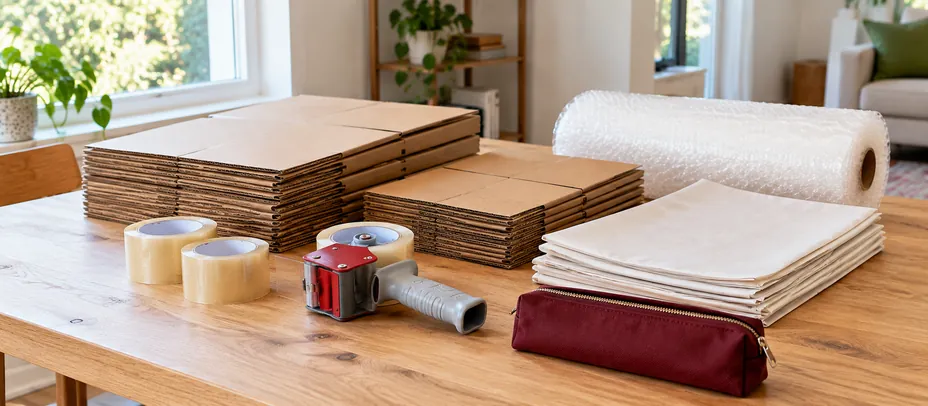
Keep cartons, packing paper, tape, protective wraps and rented equipment on separate lines. Do not price every box at the medium-box rate when your mix contains specialty cartons. Use your retailer's current prices; the amounts below are hypothetical arithmetic inputs.
| Shopping line | Quantity × assumed unit price | Cost |
|---|---|---|
| Small cartons | 12 × $2 | $24 |
| Medium cartons | 20 × $3 | $60 |
| Large cartons | 8 × $4 | $32 |
| Tape rolls | 5 × $4 | $20 |
| Paper bundle | 1 × $24 | $24 |
| Materials subtotal | Before delivery and tax | $160 |
Add costs in the right order
If delivery is $12 and the quoted tax amount is $13.60, the cash total is $185.60. This example enters tax as a known dollar amount; it does not assume which products or delivery fees are taxable in your location. A refundable blanket or bin deposit belongs in the cash-flow sheet, while the rental charge belongs in the expense budget.
A reserve of four extra medium cartons costs another $12 at the example rate. Buy whole cartons and rolls. If a product is sold in bundles, round the purchase quantity to bundles, then record the resulting leftover stock. Do not round each line's money to whole dollars before adding it.
Check the first packed room
After packing one representative room, compare cartons and paper used with the estimate. If fragile pieces consume more material than expected, revise the remaining rooms rather than applying the same multiplier indiscriminately. Save unopened materials and receipts until return eligibility is confirmed.
A meaningful comparison includes pickup travel and the cost of unused bundle quantities. Borrowed blankets may lower spending but still need counting, labeling and return arrangements. The cheapest unit price is useful only when the product fits the packing task and can arrive before it is needed.
Reviewed October 22, 2026. Workflows, quantities and USD examples are editorial planning scenarios, not market averages or a carrier quote. Confirm the terms for your move.
- U-Haul — Buying Boxes for Moving — Product box-size context; counts, sample weights and reserve percentages are editorial assumptions. (Checked 2026-10-22.)
Use this plan with
-
Packing Supplies Cost Calculator
Price a carton mix, tape and other supplies using your own unit prices, whole-item rounding and a separate…
Calculator
-
Choose a Moving Box Size Mix
Choose moving box sizes from the items you own, then test packed weight, outside dimensions and reserve…
Guide
-
Estimate Packing Tape from Box Seams
Estimate packing tape from a measured sealing pattern, box count and reserve, then round up whole rolls…
Guide
Related tools & guides
-
Guide
Budget for Stairs, Elevators and Long Carries
Describe stairs, elevators, parking and carrying distances before requesting quotes,…
-
Cost guide
Packing Service Cost: Build Your Own Estimate
Estimate professional packing from crew time, materials and unpacking scope, using a…
-
Guide
Set a Moving Contingency Without Double Counting
Build a moving contingency from specific unresolved costs, distinguish reserve from quoted…
-
Cost guide
Compare Moving Dates Using Complete Costs
Compare two moving dates using transport, time off, lease overlap and storage, with a…