
Estimate professional packing from crew time, materials and unpacking scope, using a conditional cost range you can replace with quoted rates.
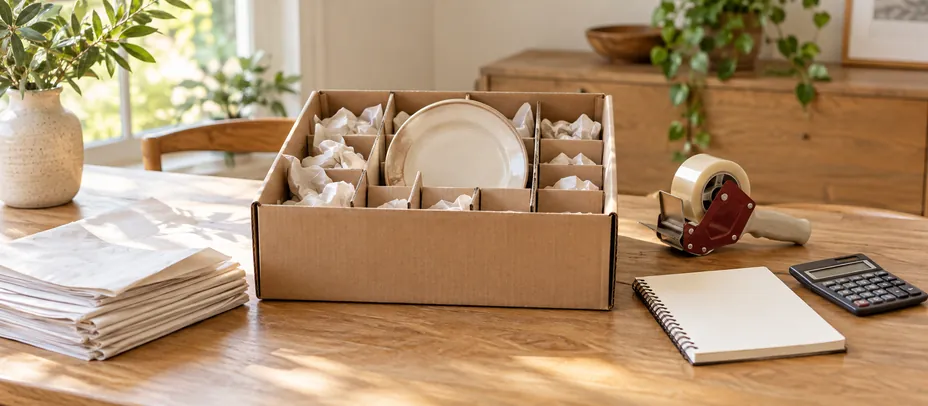
Decide what the packers are doing
Full packing, fragile-only packing and kitchen packing are different jobs. List rooms, cabinets, artwork and items already boxed. Specify whether the service includes dismantling furniture, supplying cartons, labeling, debris removal or unpacking. A per-box rate may include only a particular carton and its packing labor.
Keep moving labor separate if another team loads the truck the following day. If the same team packs and loads in one visit, ask how the company prevents overlapping time estimates. Your worksheet should identify each billable period once.
| Illustrative scope | Low scenario | High scenario |
|---|---|---|
| Two packers at $55 per person-hour | 3 hours: $330 | 5 hours: $550 |
| Cartons and protective materials | $140 | $200 |
| Separate fixed service fee | $40 | $40 |
| Packing subtotal | $510 | $790 |
Read the range correctly
The $510–$790 range is a planning example dated October 22, 2026. It is not a typical US packing price. It assumes the hourly rate excludes materials and that the $40 fee applies once. Transportation, unpacking, tips, taxes and special crating are excluded. Replace every rate and quantity with a written quote before booking.
Ask what causes the high end: more cabinets, individual wrapping, heavy books, limited staging space or fragile items. A vague allowance is hard to control. A room inventory and sample photo of open cabinets let the provider make a more meaningful estimate.
Choose partial packing deliberately
If you pack ordinary clothes and books yourself, leave a clearly marked zone for items the company will pack. Do not close fragile cartons that the company needs to inspect or repack. Keep documents, medication and travel essentials out of the packing scope entirely.
Check the carrier's valuation terms for owner-packed cartons; documenting condition and contents can matter if damage occurs. That is a coverage question for the provider, not a reason to assume all owner-packed goods have no protection.
On packing day, count supplied cartons by size and compare them with the invoice. Record unopened material returns separately. A materials credit lowers the final cost; it should not erase the original quantity record used to reconcile the shipment.
Reviewed October 22, 2026. Workflows, quantities and USD examples are editorial planning scenarios, not market averages or a carrier quote. Confirm the terms for your move.
- FMCSA — Liability & Protection — Interstate valuation choices, extraordinary value and written claims; not insurance advice. (Checked 2026-10-22.)
Use this plan with
-
Packing Supplies Cost Calculator
Price a carton mix, tape and other supplies using your own unit prices, whole-item rounding and a separate…
Calculator
-
Moving Supplies Cost: Price a Shopping List
Price moving supplies by actual carton size and pack quantity, subtract usable stock, and include tax and…
Cost guide
-
Pack Dishes with Separators and Clear Labels
Pack dishes in manageable groups with suitable cartons, individual protection, supported gaps and labels…
Guide
Related tools & guides
-
Guide
How Minimum Hours Change a Moving Bill
Calculate how a minimum charge and billing increment affect a short move, including…
-
Guide
Budget for Stairs, Elevators and Long Carries
Describe stairs, elevators, parking and carrying distances before requesting quotes,…
-
Cost guide
Moving Supplies Cost: Price a Shopping List
Price moving supplies by actual carton size and pack quantity, subtract usable stock,…
-
Guide
Set a Moving Contingency Without Double Counting
Build a moving contingency from specific unresolved costs, distinguish reserve from quoted…