
Cargo van
Decision inputs
- Actual openings, wheel wells, payload and repeated-trip cost.
Useful when
- The verified inventory fits and access favors the available vehicle.
Choose between a cargo van and box truck by checking packed item dimensions, payload, loading access, trip count and the complete rental cost.
Choose between a cargo van and box truck by checking packed item dimensions, payload, loading access, trip count and the complete rental cost.
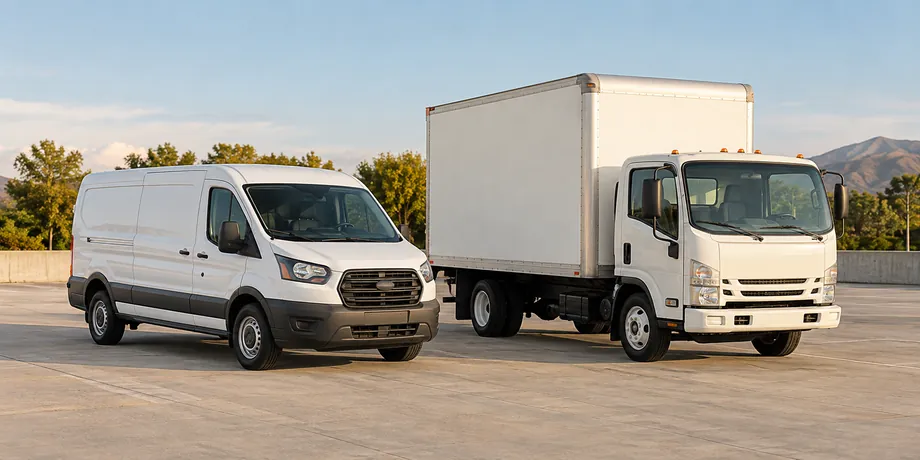
Measure your longest, widest and tallest packed pieces before comparing vehicle names. Cargo volume is useful for screening, but a narrow rear opening or wheel-well gap can rule out an item that appears to fit by cu ft. Ask for the specifications of the actual available model, then confirm them at pickup.
Make three independent checks: total packed volume with a stated allowance, total loaded weight and the path for each bulky item. Keep furniture orientation within its handling requirements. Rotating a delicate item into a theoretically smaller space may be inappropriate even if the dimensions allow it.
| Decision | Cargo van | Box truck |
|---|---|---|
| Interior shape | Check wheel wells and curved walls | Check cargo body and overhead features |
| Loading path | Measure rear and side openings | Check rear opening and ramp if fitted |
| Road access | Confirm actual exterior dimensions | Confirm height, length and parking room |
| Capacity | Verify volume and payload separately | Verify volume and payload separately |
For one provider-specific reference, U-Haul lists its 15 ft truck at approximately 764 cu ft, with a 7 ft 3 in by 6 ft 5 in rear door and a published maximum load of 6,385 lb. Those are different constraints, and assigned equipment may differ. They do not establish that another company's similarly named truck has the same capacities.
Suppose your measured packed inventory occupies 180 cu ft before a 15% planning allowance, or 207 cu ft after it. You still need to check a 7 ft shelf, the 1,100 lb total load and the doorway path independently. Neither 207 cu ft nor a bedroom count can settle those questions.
If the van requires two trips while the truck needs one, include the extra return leg, loading cycle and any extended rental period. Use actual quotes for daily charges, mileage, equipment and protection options. Avoid assuming the smaller vehicle costs less after all trips are counted.
Walk the pickup and destination approaches before booking. Consider parking length, overhead obstructions, turning room and where a ramp would land. Read the assigned vehicle's instructions and confirm the driver is comfortable operating it.
At collection, measure critical openings before leaving. If the vehicle differs from the reservation, repeat the fit and weight checks rather than relying on its advertised class. A larger alternative may solve volume while creating a new clearance or parking problem.
Decision inputs
Useful when
Decision inputs
Useful when
Bottom line
Select the actual vehicle that passes dimensions, weight and route checks; size labels alone are insufficient.
Reviewed October 22, 2026. Workflows, quantities and USD examples are editorial planning scenarios, not market averages or a carrier quote. Confirm the terms for your move.
Measure packed furniture against doors, hallways, stair landings and truck openings, then identify when…
Guide
Check moving truck payload with a separate weight ledger, actual vehicle limits and bulky-item measurements…
Guide
Test a two-trip local move against mileage, loading cycles, rental deadlines, elevator access and the verified…
Guide
Close a rental truck booking with a documented return, confirmed fuel and mileage terms,…
Compare a DIY move with full-service movers using complete costs, time commitments, access…
Build a one-way moving truck budget from the quoted package, mileage allowance, extra…
Calculate a local round-trip truck rental using every driven mile, the billed rental…
Thank you! Your feedback helps us make this page better.
Could not send. Please try again.