
DIY move
Cash
- Price equipment, fuel, help and materials separately.
Work
- Household coordinates the vehicle and every handling stage.
Compare a DIY move with full-service movers using complete costs, time commitments, access constraints and the work each option actually includes.
Compare a DIY move with full-service movers using complete costs, time commitments, access constraints and the work each option actually includes.
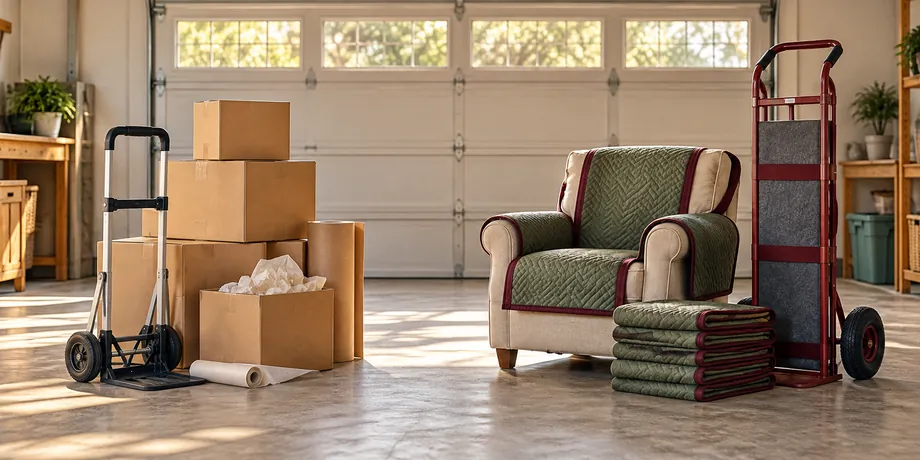
Define the outcome first: belongings packed, transported, unloaded into the intended rooms and essential furniture assembled. A truck rental covers only part of that work. A full-service quote also needs scrutiny because packing, materials, disassembly or storage may be excluded. Use the same inventory and dates for both plans.
Write a task owner beside every stage. In a DIY plan, someone must collect the truck, drive it, supervise loading, refuel it and return it. Friends who can carry boxes for an hour may not be available to unload later. A hybrid plan with paid loading help should have its own line rather than disappearing inside the DIY label.
| Hypothetical expense | DIY with help | Full-service scenario |
|---|---|---|
| Transport and fuel | $330 | Included in $1,200 quote |
| Loading and unloading | $320 | Included |
| Packing supplies | $110 | $110 excluded |
| Other known fees | $40 | $40 excluded |
| Total cash spending | $800 | $1,350 |
These invented USD amounts show a $550 difference, assuming the listed scope is complete. If the DIY plan needs 14 household person-hours and the full-service plan needs six, the household spends eight additional hours to save that amount. Do not convert those hours into a wage expense unless they actually reduce income or you deliberately choose a separate value-of-time comparison.
List practical constraints that money cannot fix on moving day: an unsuitable driver, an oversized item, unavailable help or a loading window too short for the plan. Truck volume alone does not establish item fit or payload. Check access and lifting arrangements before deciding the less expensive plan is feasible.
Ask what happens if the helper cancels, the truck is substituted or the elevator booking moves. For a mover, ask about pickup commitments, delivery timing, valuation and changes to the inventory. Keep backup arrangements specific enough to price; a general reserve does not produce an available crew.
Choose the option whose scope, cost and workload you can support. If full service is selected, retain responsibility for personal documents, access arrangements and inventory review. If DIY is selected, confirm the rental agreement, actual equipment, labor reservations and return deadline.
Revisit the comparison when a major assumption changes. Selling several large pieces may simplify DIY considerably, while adding a difficult stair carry can change both labor needs and the suitability of informal help.
Cash
Work
Cash
Work
Bottom line
Choose after checking both the complete cost and whether the people, equipment and schedule can perform the job.
Reviewed October 22, 2026. Workflows, quantities and USD examples are editorial planning scenarios, not market averages or a carrier quote. Confirm the terms for your move.
Plan labor-only loading and unloading with a defined inventory, equipment list, minimum hours, access…
Guide
Add rental days, excess mileage, fuel and quoted fees for a moving truck, keeping included miles separate from…
Calculator
Compare moving quotes on the same inventory, access conditions and services, then account for exclusions,…
Guide
Keep volume, weight, floor area and item dimensions in different columns, using worked…
Close a rental truck booking with a documented return, confirmed fuel and mileage terms,…
Choose between a cargo van and box truck by checking packed item dimensions, payload,…
Build a one-way moving truck budget from the quoted package, mileage allowance, extra…
Thank you! Your feedback helps us make this page better.
Could not send. Please try again.